
Microsoft Purview DLP: Protect Sensitive Business Data Without Blocking Productivity
Microsoft Purview Data Loss Prevention (DLP) is an important component of a modern data-protection strategy. However, effective DLP is not simply about blocking users from sharing information.
The real objective is to understand where sensitive data exists, how it is being used, who is accessing it, and how it moves across the organization, then apply appropriate controls without unnecessarily disrupting business operations.
A successful DLP strategy should protect sensitive business information while allowing employees to continue working efficiently.
What Is Data Loss Prevention?
Data Loss Prevention is a security approach designed to identify and protect sensitive information from unauthorized access, sharing, transfer, or exposure.
Organizations commonly need to protect information such as:
- Customer and personal information
- Financial and banking data
- Employee information
- Payment-related information
- Confidential business documents
- Intellectual property
- Regulatory and compliance-related information
- Business-critical data
Sensitive information can move through email, collaboration platforms, cloud storage, endpoints, and other communication channels.
Therefore, the key question is not simply:
“How do we stop users from sharing data?”
A better question is:
“How do we allow users to work with business data while reducing the risk of unauthorized exposure?”
This is where a properly designed DLP strategy becomes valuable.
Microsoft Purview DLP
Microsoft Purview DLP provides capabilities for discovering, monitoring, and protecting sensitive information across supported Microsoft environments.
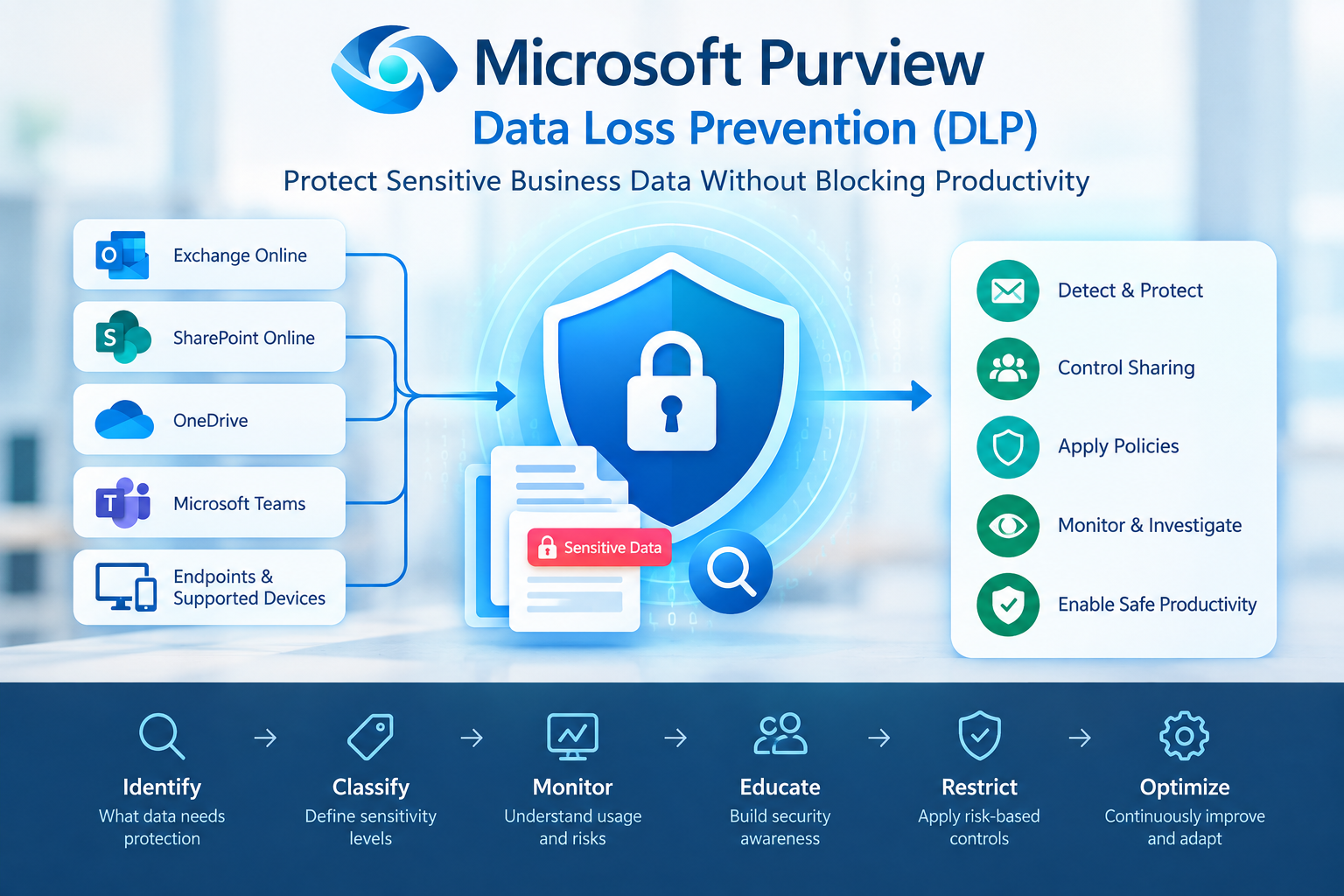
Depending on the organization’s configuration and licensing, DLP policies can help protect data across services such as:
- Exchange Online
- SharePoint Online
- OneDrive
- Microsoft Teams
- Microsoft 365 endpoints and supported devices
DLP policies can use conditions such as sensitive information types, sensitivity labels, users, groups, locations, and other organizational requirements to determine when protective actions should be applied.
The objective is to apply the appropriate level of protection based on the sensitivity and risk associated with the information.
SQLTalent Practical DLP Approach
A DLP implementation should not begin with strict blocking policies.
A more effective approach is to gradually understand the environment, identify sensitive information, observe how it is being used, educate users, and then introduce appropriate enforcement.
A practical methodology is:
Identify → Classify → Monitor → Educate → Restrict → Optimize
Each stage provides information that helps improve the next stage.
1. Identify Sensitive Information
The first step is to understand what information needs protection.
Organizations should identify sensitive data such as:
- Personally Identifiable Information (PII)
- Customer information
- Financial information
- Payment information
- Employee records
- Confidential business information
- Intellectual property
- Regulatory data
The objective is to answer two fundamental questions:
What data is sensitive?
and
Why does it require protection?
Without this understanding, DLP policies can easily become either too weak or unnecessarily restrictive.
2. Classify the Data
After identifying sensitive information, organizations should establish an appropriate classification model.
For example:
Public → Internal → Confidential → Highly Confidential
The exact classification structure should be aligned with the organization’s information-security and governance framework.
Sensitivity labels can provide additional context around the information and can be integrated with broader information-protection strategies.
Classification helps security teams determine which information requires protection and what level of protection should be applied.
3. Monitor Before Enforcing
One of the most important recommendations when implementing DLP is:
Monitor first. Enforce later.
Before blocking user actions, organizations should understand how sensitive information is actually being used.
Monitoring can help identify:
- Where sensitive information is stored
- Who is accessing it
- How it is being shared
- Which services are involved
- Which policies generate incidents
- Which activities are legitimate business processes
- Where false positives occur
This visibility is critical because a policy that looks correct from a security perspective may have unexpected consequences for business operations.
4. Educate Users
DLP should not be treated purely as a technical control.
Users are an important part of the data-protection strategy.
Policy tips, notifications, and user guidance can explain why a particular action has triggered a DLP policy.
For example, instead of simply displaying:
Access Denied
organizations can provide meaningful guidance explaining:
- Why the action was detected
- What type of sensitive information was identified
- What the user should do next
- Whether an approved business process is available
This approach improves security awareness and can reduce repeated policy violations.
5. Apply Risk-Based Restrictions
Once policies have been tested and tuned, appropriate enforcement controls can be introduced.
Depending on the business requirement, organizations may configure controls such as:
- Blocking specific actions
- Restricting external sharing
- Generating alerts
- Requiring user justification
- Applying additional protection
- Notifying security teams
- Allowing controlled overrides
The important principle is:
Apply the minimum restriction necessary to manage the identified risk.
Not every sensitive-data event requires a complete block.
Avoid the “Block Everything” Approach
One of the most common mistakes in DLP implementations is creating policies that are too restrictive.
For example, blocking every attempt to share sensitive information externally may reduce certain security risks, but it can also interfere with legitimate business activities.
Employees may legitimately need to exchange information with:
- Customers
- Vendors
- Business partners
- Auditors
- Regulators
- External consultants
If security controls continuously prevent legitimate work, users may eventually look for alternative methods to transfer information outside approved channels.
This can create a different security problem.
Therefore, DLP should be designed around risk-based controls rather than blanket restrictions.
Reduce False Positives Through Continuous Tuning
No DLP policy is perfect when it is first deployed.
During implementation, security teams may discover legitimate business activities that are incorrectly identified as risky.
Continuous policy tuning may include:
- Reviewing DLP incidents
- Adjusting policy conditions
- Improving sensitive information detection
- Refining sensitivity labels
- Reviewing user and group scope
- Creating appropriate exceptions
- Adjusting enforcement actions
- Monitoring recurring policy violations
The goal is to improve detection accuracy while minimizing unnecessary disruption to users.
Phased DLP Rollout
A phased rollout is generally more effective than immediately enabling strict enforcement across the entire organization.
A practical deployment model can be:
Phase 1 — Discovery
Understand the organization’s sensitive information and existing data flows.
Phase 2 — Classification
Define sensitive information types and appropriate sensitivity labels.
Phase 3 — Monitoring
Deploy policies in audit or monitoring mode and analyze the results.
Phase 4 — User Awareness
Introduce policy tips, notifications, and security awareness.
Phase 5 — Controlled Enforcement
Apply restrictions to clearly identified high-risk scenarios.
Phase 6 — Optimization
Continuously review incidents, exceptions, false positives, and business impact.
This phased approach allows security teams to understand the real-world impact of DLP policies before introducing stronger enforcement.
Centralized Monitoring and Investigation
Creating a DLP policy is not the end of the implementation.
Security teams need continuous visibility into what happens after policies are deployed.
Centralized monitoring and reporting can help identify:
- DLP policy violations
- Repeated user activities
- Sensitive-data exposure attempts
- High-risk events
- Frequently triggered policies
- Business processes generating false positives
This information can support security investigations and help security teams determine whether policies need to be adjusted.
DLP monitoring should therefore become part of the organization’s ongoing security operations rather than a one-time implementation activity.
DLP and Compliance
DLP can also contribute to broader compliance and information-governance programs.
Organizations may use DLP as one component of controls supporting requirements related to:
- GDPR
- ISO 27001
- Financial regulations
- Privacy requirements
- Industry-specific security standards
However, DLP should not be considered a complete compliance solution by itself.
Compliance requires a broader combination of:
People + Processes + Policies + Technology + Governance + Monitoring
DLP should therefore be considered one component of the organization’s overall information-security and data-governance framework.
DLP and Sensitivity Labels
DLP becomes more effective when it works together with information classification and sensitivity labels.
For example, an organization may define:
| Classification | Example | Typical Protection |
|---|---|---|
| Public | Public website content | Minimal restrictions |
| Internal | Internal procedures | Internal access |
| Confidential | Customer/business information | Controlled sharing |
| Highly Confidential | Sensitive financial or regulated data | Strong restrictions and monitoring |
This provides a structured approach to determining how information should be handled.
The classification model should always reflect the organization’s actual business and regulatory requirements.
DLP Is a Continuous Journey
Data protection is not a one-time deployment.
A mature DLP program continuously evolves as the organization, technology, users, and business processes change.
A simple way to visualize the approach is:
Identify → Classify → Monitor → Educate → Restrict → Optimize
Identify what information needs protection.
Classify information according to its sensitivity.
Monitor how that information is being used.
Educate users about secure data handling.
Restrict high-risk activities when appropriate.
Optimize policies based on real-world results.
This cycle allows organizations to continuously strengthen their data-protection posture while minimizing operational disruption.
Key Takeaways for IT and Security Teams
When implementing Microsoft Purview DLP, consider these principles:
1. Start With Visibility
Understand the data and its movement before attempting to control it.
2. Classify Information Properly
Effective protection depends on accurately identifying sensitive information.
3. Avoid Excessive Restrictions
Security controls should reduce risk without unnecessarily affecting business operations.
4. Monitor Before Enforcement
Use audit and monitoring capabilities to understand the impact of policies.
5. Educate Users
Users should understand why a policy is triggered and how to handle sensitive information correctly.
6. Continuously Tune Policies
Review incidents, false positives, exceptions, and business requirements regularly.
7. Manage Exceptions Carefully
Exceptions should have a valid business justification, appropriate approval, and periodic review.
8. Treat DLP as an Ongoing Program
Data protection requires continuous monitoring, assessment, and improvement.
Microsoft Purview DLP Architecture
Final Thoughts
The goal of Data Loss Prevention is not to stop people from working.
The goal is to help people work securely with the data that drives the business.
A successful Microsoft Purview DLP implementation therefore requires more than creating policies and enabling enforcement.
It requires an understanding of the organization’s data, appropriate classification, continuous monitoring, user awareness, risk-based controls, and ongoing optimization.
The most important lesson is simple:
Protect the data without becoming an obstacle to the business.
When security and productivity are considered together, DLP can become more than a collection of restrictive policies—it can become an effective part of an organization’s broader data-security and governance strategy.
SQLTalent Perspective
At SQLTalent, we believe effective security is not measured by how many activities an organization can block.
It is measured by how effectively the organization can protect critical information while allowing the business to operate securely and efficiently.
Identify. Classify. Monitor. Educate. Restrict. Optimize.
That is the journey toward a mature DLP strategy.
